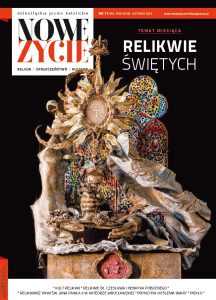
Dimensions: 75 x 30 x 105 cm
Materials: Bronze sculpture, lost wax technique, in vacuum, fire patina, enamel on copper and glaze 835 °C, agate geode, gilded elements.
The purpose of this work is to preserve the blood of Saint Pope John Paul II and to commemorate his visit to Wrocław Cathedral during the 46th Eucharistic Congress. This work allows us to notice the presence of the Holy Father John Paul II, even though the intention is not to show his entire figure or his face. However, thanks to the outline of the White Shepherd, he becomes very clear and recognisable.
The hands of Peter's Polish successor, already showing the beginnings of degeneration, with a golden fisherman's ring, clasp a decorated monstrance, bringing Christ in the Eucharist to the fore. This monstrance, which is a sculptural paraphrase of the radiant monstrance actually used by John Paul II during the adoration of the Blessed Sacrament on 31 May 1997 in Wrocław Cathedral, is intended to be a reference to the Tradition of the Church, and in particular to the tradition of the Archdiocese of Wrocław. Therefore, it is not meant to be a copy of the original, but an artistic expression, a means which, thanks to recognisable elements referring to the exhibit from the cathedral treasury (1672), combines with contemporary forms developed by the artist.
The reference to the radiant monstrance not only transports us to a specific place and time, namely 31 May 1997, but also helps to fully express the idea of the continuity of time in the Church. Tradition and the present are present at the same moment.
The Church is the Living Mystical Body of Christ, the same - though different, eternally lasting. In this Church, the same Christ is always present.
The figure of St. John Paul II remains in the background of the monstrance. Christ is always in front of him, because John Paul II wanted Christ to always be in the first place. The brightest point of the composition is therefore the symbol of the precious Host. The figure of the Pope ‘lives’ by its light. The light emanating from the monstrance illuminates the figure, which is literally sustained by flames and filled with a breeze.
This action of the Spirit, who “blows where he wills” (cf. Jn 3:8), is represented in this sculpture in the form of tongues of fire and elements and fabrics clearly moving in the breeze. This gentle ‘breath’ frees the small sculptural forms from the rigid composition of the liturgical vessel, breaking the glazed and rigid geometric rays around the monstrance, directing them as if by a vortex of mysterious force upwards to God the Father. These fragments of rigid elements are transformed into natural, soft forms that fill the space, rising from the bright Host, made of precious geode agate stone – the brightest point of the composition, right up to the stained glass windows of Wrocław Cathedral. Other delicate, gilded, soft forms settle around the Host, completing the ring.
Looking at the Host against the light, we see the delicate inscription Eucharistia et libertas – Eucharist and freedom, which is the motto of the 46th International Eucharistic Congress.
The symbolically represented stained glass windows allow us to immediately recognise the interior of Wrocław Cathedral. They are not made of glass.
Here, they are made of copper and subjected to precise glazing, similar to the monstrance. Light passes through the empty spaces. The monstrance depicted in the sculpture is raised above a base that is part of the altar, which is also the place where the relics are kept.
New Life: November 2022 — Issue Topic: "Relic chasuble of the blood of St. John Paul II" — author: Małgorzata Maria Winnik


 Polish Polish
  English
 Italian