In the space between silence and light,
form is born

I create by listening to what is invisible, yet deeply felt.

MARGHERITA WINNIK

My name is Margherita (Małgorzata Maria) Winnik. I was born in 1974 in Wrocław, and from an early age I felt that the world spoke to me through forms, textures, and light. I studied passionately at the Academy of Fine Arts in Perugia, where I defended my thesis on the materiality of visual language, and then perfected my sculpting techniques, especially metal casting, at the University of Barcelona.

My work is always directed toward the invisible, the spiritual – hence my fascination with contemporary sacred art.I create works that penetrate sacred spaces, as well as the intimate world of homes of those who desire to experience beauty. Where art is meant to be a spiritual experience, a subtle sign of the presence of beauty and faith in everyday life

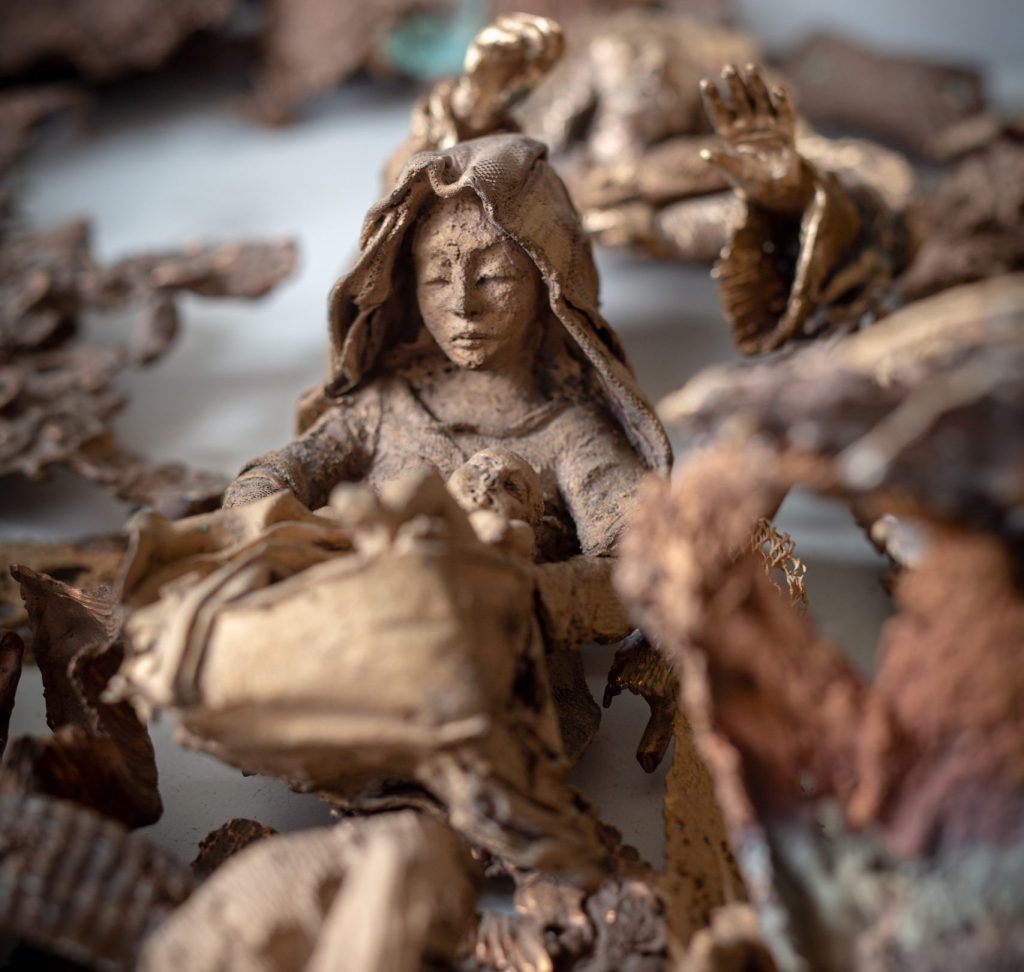
My work is a dialogue with space and light, a search for harmony between architecture and form, experimenting with materials and technologies. I work in metal casting (lost wax casting, microcasting, sand casting) and ceramics, creating glazes and decorations that transform volcanic stone into almost magical objects.

My artistic journey is an encounter between matter and the ephemeral, a place where sculpture and installation become a story about man, his search for meaning, beauty, solace, and truth. My works arise from contemplation. From silence, which teaches us to see. From attentiveness to light, which reveals what is fragile and moving. From the need to give shape to what we carry within ourselves: loneliness, desires, memories, longing, faith, the memory of time. I am interested in the moment of inner movement in the viewer, when matter ceases to be just matter and becomes an experience. When the gaze lingers a moment longer. When the silence deepens. I create sculptures and installations out of a need for dialogue, with God,with myself, with other people, with the space that invites us to pause. For me, art is a form of presence.

I collaborate with world-renowned Italian foundries.

I have lived and studied in Wrocław, Barcelona, Perugia, Gorizia, and Frosinone, where I currently create, allowing places and their energy to shape my works.

MY EXHIBITIONS

Art comes alive when it meets the gaze.

Art comes alive when it meets the gaze. Each exhibition is a space where works gain new life—in dialogue with the viewer, light, and space. It is a place where the artist meets the audience, where emotions, reflections, and inspirations become part of a shared experience.

Gardens
Inside

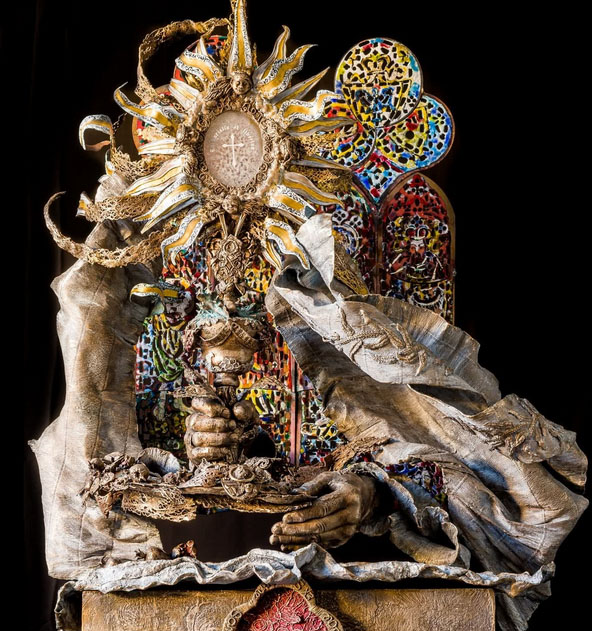
RELIC CHASUBLE OF THE BLOOD
OF SAINT JOHN PAUL II

Only
From Love

CRITICS

Words open windows through which the world enters art.

For me, the voice of a critic is more than just an evaluation; it is a light that is reflected in my forms and colors. Their reflections allow me to see nuances that I might not have noticed myself and give my work new dimensions.

On this page, I have collected the words of experts who have accompanied me on my artistic journey. Each opinion is like an echo of an encounter, like a subtle bridge between my world and the world of the audience. Together, we create a space where art lives more fully.

In her poetic declaration, Margherita Winnik affirms an almost obsessive interest in what, in sculpture, denies forms the status of objects. At the same time, she introduces a natural morphology in which neither the presence of the hand nor the technical processes leading to the creation of the work can be discerned. Furthermore, the Polish artist possesses a precise concept of emptiness: it is an experience leading to fullness, a narrow gateway that opens to that which nourishes the materiality of artistic language and the practicality of experiencing reality. The results: traces that evoke primordial clay and fragments of cosmogonic events, signs and gestures developed beyond the historical idea of form and predating even the archetypal model. Despite this striving for primordiality, Winnik's traces have nothing organicist about them. Rather, they preserve an energy that imprints itself on the reality of the finds, focusing a creative attention that has nothing to do with the energetic mythology of Poverism. For here, force is provided as a heroic variable within an economy that is always close to revealing it, causing it to explode at the moment of maximum tension.

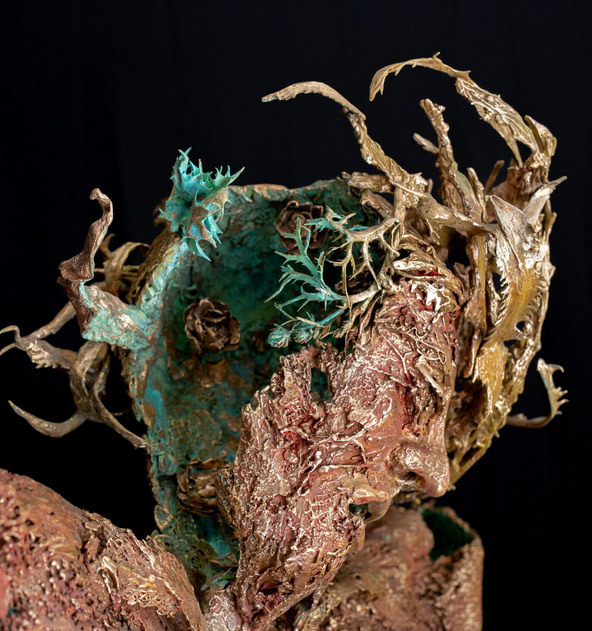
Margherita Winnik's work, titled "Intimacy," is an aluminum alloy that encapsulates the story of a random process in which the artist, with aesthetic foresight, combined organic materials—such as leaves, bark, and fabrics—with Styrofoam and wax to create a whole, upon which a mold was built. Liquid metal was poured. As it burned, it left traces of burnt elements in the metal. The final result retains its identity, which continues to live on as a natural substance, with a strong, tangible surface: a kind of highlighted tree bark that, in cracks or widening crevices, shimmers with extreme reflections of light. Closely observed, the work exudes a sense of spatiality that transcends its form, and the end result is that the work lends itself to a variety of construction applications: vertically, it can transform into a lysine covering, and horizontally, it can become a spectacular wall rib.

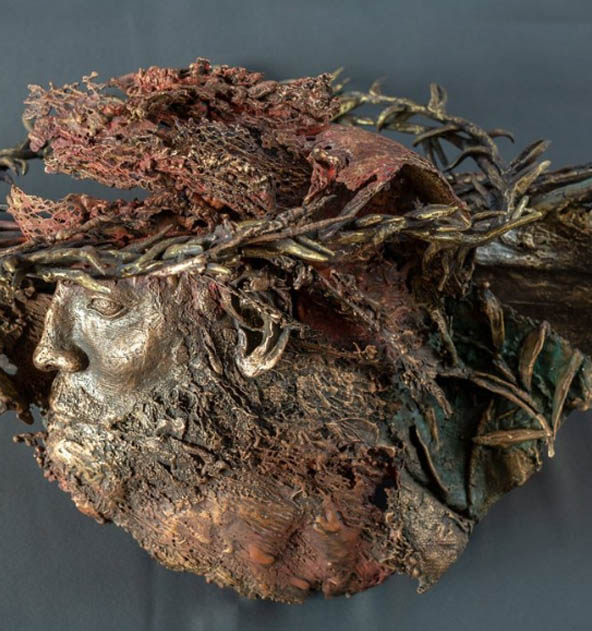
An emphasis on three-dimensional deepening of shadows: the sculpture Malgorzata Winnik created for the chancel of St. Michael's Church. Drawing inspiration in part from Visconte di Calvino's "cutting in half," the artist formally explores ethical boundaries—between good and evil, between what is useful and what is just—which we emotionally perceive as an expression of our inner geology. She does this using aluminum layers, which can be interpreted as dry stubble or shale torn apart by an earthquake from the millennia-old stability of apparent equilibrium. In their interstices, one feels the dark weight of drama, but one also perceives light; one experiences the tormented dualism that our tradition has transmitted in the art of sublime crucifixes, but whose cultural roots reach back to the rifts of the pre-Christian world. After all, "...only in this way can the work of art fulfill its cathartic function: through a perfect form given by a content that can be nothing other than opaque, dark, ambiguous, and permeated with death; in other words, mythical: because it is myth that reflects the ambiguity of existence and always implies the need for salvation through total renewal: death and resurrection.

MY PROJECTS

Creation is a journey we can embark on together.

My work constantly seeks new spaces and challenges. Each project is a separate world—from sacred sculptures, through installations in public spaces, to works for the homes of those who want to bring art into their everyday lives.

On this website, you will find my current projects that I am working on. Each work is a carefully thought-out concept, based on a dialogue with matter, light, and space.

For those who want to support the creation of new works, I have prepared the possibility of co-financing projects. Thanks to your help, each project can take shape and reach spaces where art becomes an everyday experienc

Current support opportunities:


Each work is created through deep listening and a sincere desire to give shape to intuition, inspiration, and an inner calling. Unlike the great works of the past, sacred art that is not commissioned today has increasingly rare opportunities to be realized. Patrons and institutions that cover the costs are becoming increasingly rare. What remains is the artist, their vision, and the responsibility, both material and spiritual, for its realization. With every gesture of support, large or small, you can directly contribute to the creation of a work by helping to transform wax into bronze, so that a work without a commission can speak to the hearts of all. If you feel this project resonates with you, please support us via the
A contribution is a voluntary donation intended for the realization of the work; it is not a sale and does not involve any remuneration.
Fill out the form to stay up to date with project developments.

    Antoni Gaudí has ​​been declared a "Venerable Servant of God," a title that is the first step in the beatification and canonization process through which the Catholic Church establishes new saints. Driven by my strong conviction of his holiness, I would like to be "ready" for this great moment of proclaiming Gaudí, the architect of God, blessed by creating a monumental sculpture-reliquary. The sculpture depicts the architect dressed in a striking tie and eccentric shirt, a rosary ("his weapon") discreetly visible in the pocket. The figure seems immersed in the Catalan artist's astonishing world of ideas. His bust is surrounded by forms that evoke the world of Antoni Gaudí. This artistic paraphrase of his works, often symbolic, refers to God the Creator, who has always held a primary place in his work.